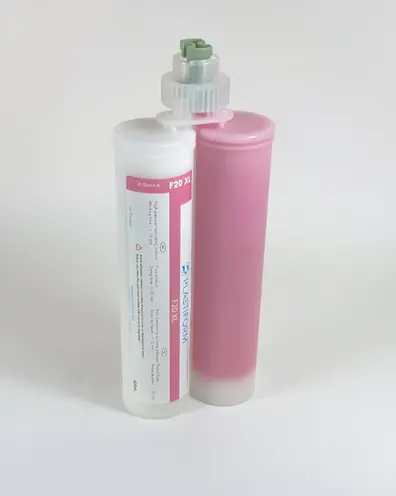
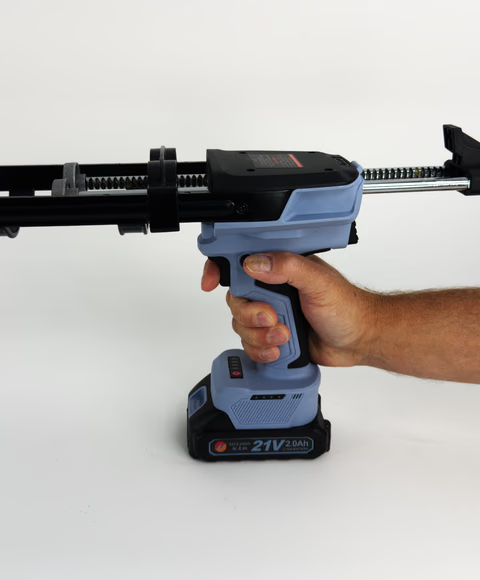
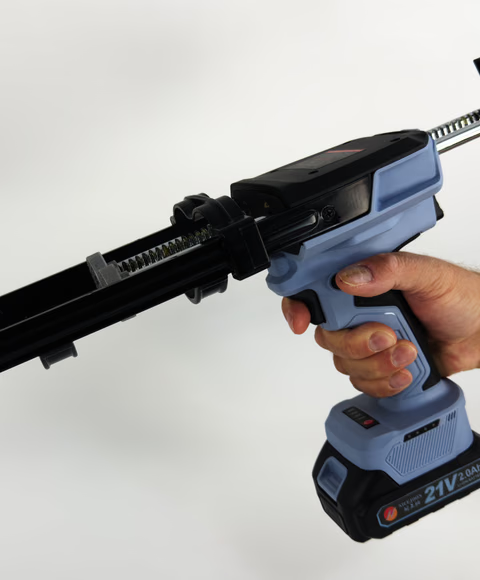
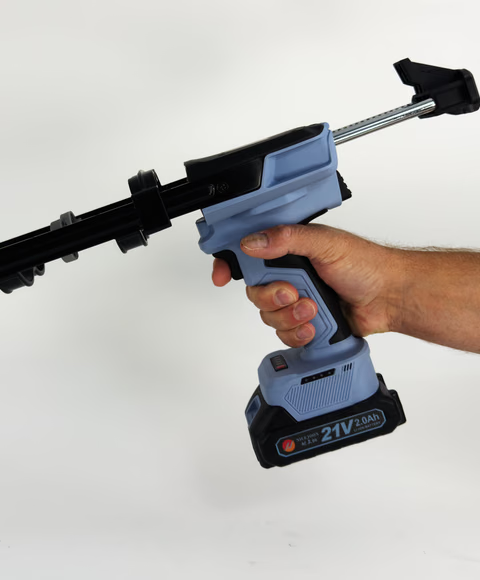
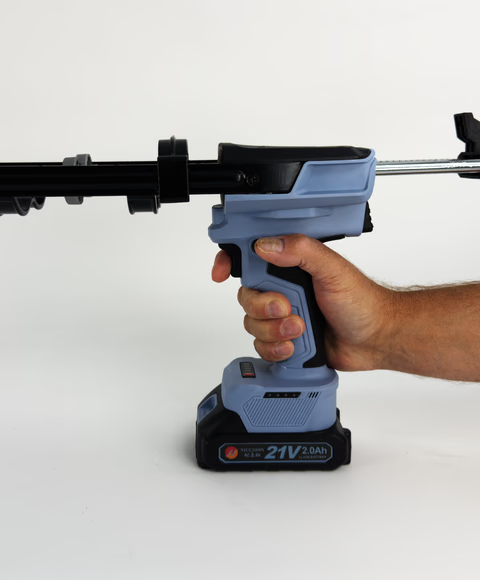
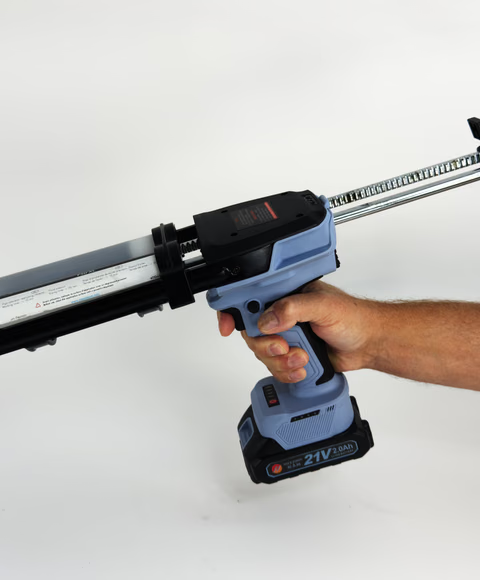
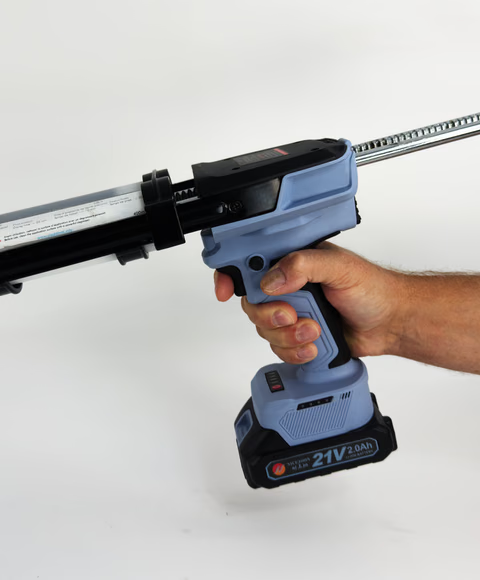
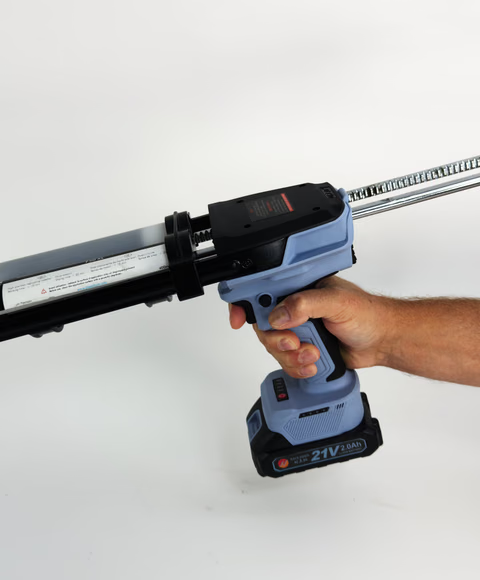
The DB-400 is a battery-powered dispensing gun made to apply Plastiform products in 400 ml cartridges with a Long Nozzle.
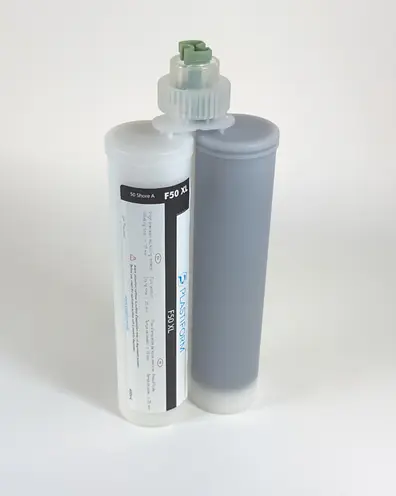
This dispensing gun takes 400 ml cartridges only. It works with the Plastiform XL range: F20 XL, F30 XL, F50 XL and F85 XL.
The battery drive pushes the pistons without hand effort. The operator controls the flow with the trigger, which helps avoid air bubbles during injection. The gun keeps a constant 1:1 mixing ratio between the two components for the product to polymerize properly.
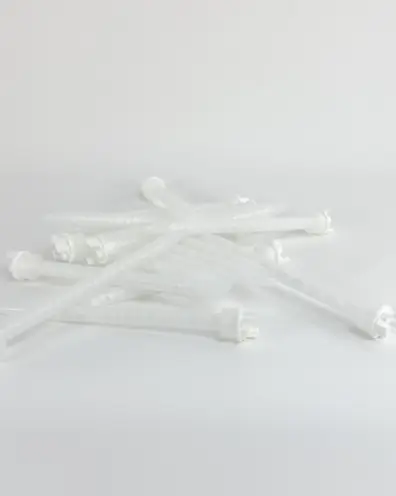
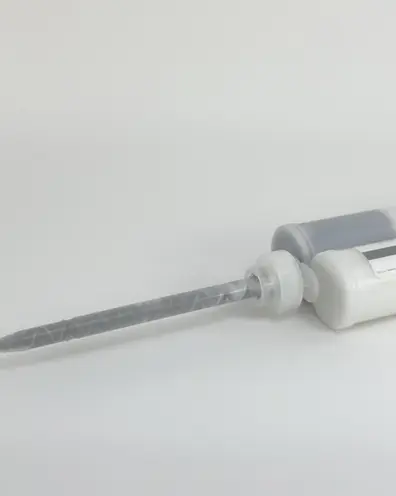
You must use a Long Nozzle on the 400 ml cartridge to get this 1:1 mix. The nozzle is a consumable that you replace after each use. Before injecting onto the part, check at the nozzle outlet that the mix is uniform with no marbling.
Pushing large volumes with a manual gun is hard on the hand, the use of the DB-400 removes this effort and makes it easy for your operators to handle a large amount of impression a day. It is a long-term tool suited to operators who take many large impressions or work over long periods.
Applications
Use the DB-400 for applications with a 400 ml Plastiform XL cartridge when you want to avoid the hand effort of manual injection. For occasional use, the DM-400 is the manual dispensing gun for 400 ml cartridges.
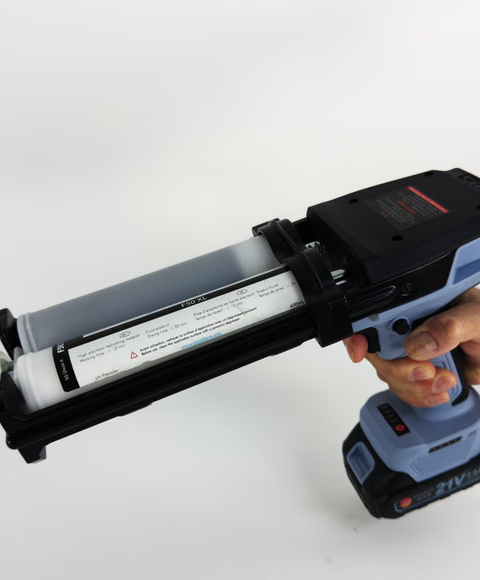
To fit a cartridge to the gun:
Pull the plunger back as far as it goes,
Place the 400 ml cartridge in the cradle with the outlet facing forward,
Fit a Long Nozzle onto the cartridge,
Press the trigger to push and mix the two components,
Check at the nozzle outlet that the mix is uniform, discard the first non-uniform part, then take the impression.
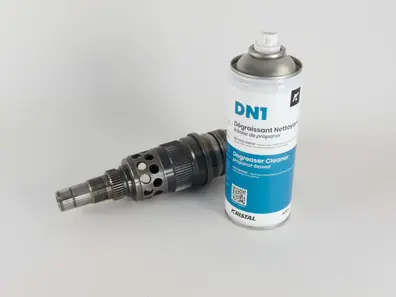
Before every impression, degrease the part with the DN1 degreaser.
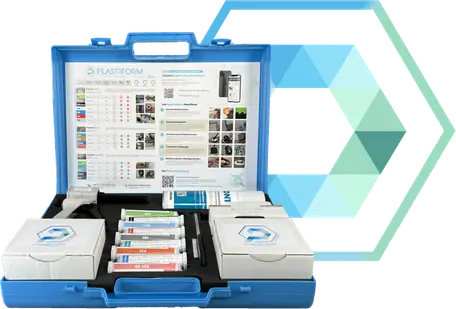
Looking for a complete kit to try plastiform?
The case contains all required accessories to use Plastiform. It is the best way to try our solutions for the first time!
Which product should I use to control dimensions of my part?
Every application and every part are different. This is why we developed the Plastiform Finder, which can help you find the right product after asking you some questions about the context. Use it or contact us to find the best product !
What’s the difference between manual, pneumatic and battery application guns?
Manual guns are simple and portable but can cause hand fatigue. Pneumatic guns provide consistent application and reduce fatigue, while battery guns offer portability and ease of use without manual effort.
Are there any materials to which plastiforms cannot be applied?
It is possible to apply our products to any type of material and its alloys (including gold, silver, titanium). They can also be used on plastic materials, wood, resins, etc. However, certain silicone-based materials should be avoided, as they can sometimes alter the polymerization of the products. We always recommend a test before use.
Can an underwater impression be taken?
Impressioning can work without problems underwater, and more generally in any environment without oxygen.
Can anyone use Plastiform products?
Yes, anyone can use Plastiform products as long as they follow the instructions provided with each product. While no specific training is required, we strongly recommend adhering closely to the guidance in the technical documents. If you have any doubts, a series of explanatory videos is available to help clarify your questions. If these do not resolve your concerns, please do not hesitate to contact us.
How to clean the injection material after taking the impression ?
You don't need to clean the material. The nozzle is going to trash and the tip is reusable after extracting the polymerized material inside it.
How to correctly extract a Plastiform impression?
Plastiforms are highly precise, ensuring that once cured, they maintain perfect contact with the walls of the part, almost as if they are glued. To extract an impression: have a firm grip to pull energetically along the axis of the impression—twisting or unscrewing should be avoided. For this, it is essential to use demolding rings.
How to ensure that the products are properly mixed at the outlet of the mixing injector? Or during manual mixing?
At the end of the injector, or after manual mixing, the product must be well mixed to ensure uniform polymerization. If the mixture appears marbled, indicating that it is not homogeneous, set aside the non-homogeneous part until the mixture is correct. Once the mixture is homogeneous, you can proceed with the impression.
Related Products
Considered the DB-400 for your application but it doesn't exactly answers to your requirements? You may also find these alternative products helpful.

 AC-021-B