
Last updated:
Non-Destructive Testing (NDT) is a set of analysis techniques designed to evaluate the properties of a material, component, or system without causing damage.
Unlike destructive testing, where you physically stress a part until it breaks, NDT allows you to inspect the structural integrity and employ defect detection techniques on a part while keeping it fully intact for future use.
I used to find the concept of quality assurance a bit stressful. The idea of taking a perfectly good part off the production line and destroying it (tensile testing, anyone?) just to prove it was strong seemed like a total waste.
It turns out, this is a common friction point in manufacturing. We want to secure safety assurance, but we also want to actually use the parts we make.
That is where Non-Destructive Testing shines.
Whether you call it Non-Destructive Evaluation (NDE), Non-Destructive Examination, or Non-Destructive Inspection (NDI), it’s identical: we are looking at preserving usability while guaranteeing quality.
It is such an essential part of modern industry that the BLS expects employment for NDT technicians to exceed 72,000 by 2033.
In this post, I’ll share the definition of NDT, its primary goals, and the industry applications that rely on it.
We will also break down the most common NDT methods and techniques including a look at the highly effective ultrasonic testing method and the Impression Based Testing.
Let’s get into it!
Table of Contents
What is Non-Destructive Testing?
Non-Destructive Testing (NDT) refers to analytical procedures that examine material properties and structural integrity without altering or damaging the component under inspection.
The core idea is simple: we need to verify that a part is safe and functional, but we cannot afford to break it in the process.
When a product passes an NDT inspection, it remains fully usable.
It can continue straight through the supply chain, be installed in an engine, or be sold to a customer. This contrasts with methods that require sacrificing a sample to prove a batch is good.

NASA defines this methodology effectively: it is the inspection of materials and structures “without causing any detrimental effect on their future usefulness.”
You can read more about their rigorous approach at the NASA NDE Program.
By using NDT, manufacturers ensure product integrity while maintaining production speed and reducing waste.
NDT as a Measurement Activity
It is easy to view NDT as a simple “pass/fail” check.
However,
For a metrology engineer, NDT data must be treated as proper measurement data. Just like a caliper reading or a CMM plot, NDT results carry statistical weight.
Structural integrity decisions rely on quantified metrics like Probability of Detection (POD), the false call rate, and measurement uncertainty.
In modern manufacturing, we do not just ask “is there a crack?” We ask, “what is the size estimation of the defect, and what is the confidence level of that measurement?”
Validating these systems requires the same rigor as calibrating a micrometer. You must account for variable conditions to establish a reliable baseline.
Destructive vs Non-Destructive Testing
The distinction often trips people up, but it comes down to the state of the part after the test.
Destructive Testing (DT) involves pushing materials until they fail. Common DT methods include tensile testing (pulling metal until it snaps), hardness testing (denting the surface), and impact testing.
While this provides concrete data on limits like yield strength, it renders the tested sample unusable. Companies must allocate extra budget to create samples specifically to be destroyed.
Non-Destructive Testing evaluates the material without inflicting damage.
Because the item remains in service, NDT is ideal for ongoing maintenance and inspection of high-value assets, such as pipelines or aircraft wings, where destroying the part is obviously not an option.
Goals of Non-Destructive Testing
Non-destructive testing generally serves two primary purposes:
- Quality Control during the manufacturing process,
- Asset Maintenance for equipment currently in service.
While many industries perform these tests to meet strict compliance requirements, the practical goal is catching issues early.
Identifying a problem like corrosion or a hairline crack before it spreads prevents costly leaks, critical deformations, and sudden equipment failures.
The financial impact of ignoring these inspections is massive.
It is estimated that Fortune Global 500 manufacturing and industrial firms lose over $1.5 trillion yearly to unplanned downtime.
By implementing a consistent NDT schedule, you move from reactive repairs to predictive maintenance, ensuring your production lines stay running and your operational costs stay predictable.
Safety Assurance
The most important function of NDT is preventing accidents.
The goal is to identify hazardous conditions (such as stress fractures or wall thinning) long before a component reaches its breaking point.
This is non negotiable in high risk environments where failure could lead to injury or environmental disaster.
For example, technicians routinely test pipelines capable of carrying hazardous materials like oil, gas, or nuclear elements.
They also verify the integrity of high stress welds in the transportation and infrastructure sectors. In these scenarios, the NDT technician acts as a safeguard.
Their work maintains the safety of important machines and structures, protecting the personnel who operate them.
Quality Verification
In a manufacturing context, NDT allows you to guarantee product quality without sacrificing the test samples.
Unlike destructive testing, where you might crush a part to prove it was strong, NDT verifies the integrity of the actual unit being sold. It is standard procedure for inspecting castings, forgings, and complex machined components.
This approach creates a significantly more accurate testing process.
Instead of testing a random sample and assuming the rest of the batch is fine, you can verify 100% of the lot (even if, in practice, it is not always optimal, I agree).
This ensures no defective parts slip through to the client, which directly improves customer satisfaction and reduces liability.
Checking welds is one of the most common applications of NDT for quality verification. For a deeper look at how this works, read our guide on Welding Quality Control.
Cost Efficiency
Because products that pass NDT can move directly through the supply chain, this method drastically reduces material waste.
Companies save both time and money by not having to allocate resources to create specific “sacrificial” samples for destructive testing.
If you test the real part and it passes, it gets sold.
Beyond production savings, regular NDT helps avoid operational failures. It is always more cost-effective to repair a minor defect found during inspection than to replace a major piece of equipment that failed unexpectedly.
Regular non destructive evaluation helps you extend the useful lifespan of your assets and avoids the capital expense of early replacement.
Common NDT Methods and Techniques
Non-Destructive Testing isn’t a single method, it’s a whole category. It creates a complete toolbox built on physics.
Choosing the right scientific principle determines whether you find a micron scale crack or miss it entirely.
While there are dozens of specialized techniques, the industry relies heavily on six primary methods (often called the “Big Six”) to handle the vast majority of defect detection techniques.
Each method relies on a specific physical property, from electromagnetism to capillary action.
Selecting the correct one is inherently tricky because performance depends on the material type and the flaw location.
You wouldn’t use a magnet to inspect aluminum, and you can’t use light to find a void inside a solid steel block.
Visual Testing (VT)
Visual Testing (VT) is simple: it involves looking at the part directly. However, it is the most common NDT method across every industry because it catches obvious issues instantly.
Before we apply expensive technology, we strictly rely on the trusted combination of the naked eye and good lighting.
You can use VT at any stage of a component’s lifecycle. To see beyond human limits, we use optical aids like magnification, borescopes, and high-resolution cameras.
In fact, VT is almost always the first step before applying other NDT methods and techniques. If a weld looks terrible on the surface, there is no need to X-ray to know there is an issue.
Ultrasonic Testing (UT)
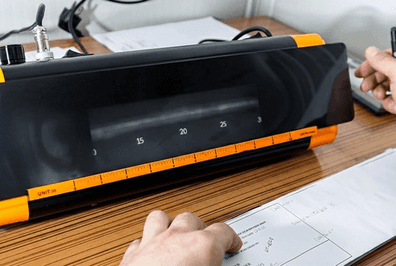
When you need to see inside a material without radiation, you use the ultrasonic testing method.
This technique uses high frequency sound waves (well above human hearing) to detect both surface and subsurface discontinuities. It works largely like sonar or radar but for solid materials.
A device called a transducer transmits sound pulses through a test piece via a probe.
These waves travel through the material until they hit the other side (or a defect).
If the sound wave hits a reflector (like a crack or void) within the material, it bounces back to the transducer as an electric impulse. We analyze the timing of that echo to pinpoint the flaw’s depth.
UT is standard for inspecting pressure vessels, machinery shafts, and pipelines. It is incredibly sensitive to deep flaws that other methods miss.
Radiographic Testing (RT)
Radiographic Testing (RT) uses penetrating radiation (typically X-rays or gamma rays) to create images of a component’s internal structure.
This is essentially a medical X-ray for industrial parts.
It is one of the most trusted radiographic testing applications because it provides a permanent visual record of the internal quality.
The process is straightforward: it creates a shadow image. We place a radiographic film or digital detector on the opposite side of the metal part.
Then, we apply a radiation source. Denser material absorbs more radiation, while discontinuities (like voids or cracks) let more radiation pass through, causing the film to darken in that specific area.
For thicker, denser materials, we often use powerful radioactive isotopes like Iridium-192 (effective up to 7 cm thickness) or Cobalt-60 for even heavier objects.
RT is the primary choice for inspecting castings, weldments, and complex mechanical assemblies.
Magnetic Particle Testing (MT)
Magnetic Particle Testing (MT) is a clever way to find impurities on or just below the surface of ferromagnetic materials.
If you can magnetize the material (like iron or steel), you can test it.
If the material is non-magnetic (like aluminum), this method physically will not work.
We start by creating a strong magnetic field in the part. If there is a crack, the magnetic field lines “leak” out of the part at that spot.
We then apply colored magnetic particles (iron filings), either as a dry powder or suspended in liquid.
These particles are instantly attracted to the magnetic leak, grouping together to form a highly visible indication of the flaw.
Liquid Penetrant Testing (PT)
Liquid Penetrant Testing (PT) relies on capillary forces to find surface defects.
It is a low-cost, effective way to find cracks, but there is a major “gotcha”: the defect must break the surface. If the crack is sealed under the skin, PT cannot find it.
The process involves cleaning the part and applying a liquid penetrant (often red dye or fluorescent fluid).
We let it sit so the liquid seeps into tight spaces. After wiping away the excess penetrant, we apply a developer powder.
This acts like a blotter, pulling the trapped penetrant back out to reveal cracks, laps, and porosity. It is widely used on non-ferromagnetic materials like stainless steel, aluminum, and various alloys.
Eddy Current Testing (ET)
Eddy Current Testing (ET) is a sophisticated form of electromagnetic testing.
Instead of magnetizing the part directly, we use an alternating current coil to create a magnetic field near the conductive material.
This induces small, circular electrical currents (called eddy currents) directly inside the test piece.
We monitor exactly how these currents flow. If the current encounters a crack or a change in material property, the flow is disrupted, and the impedance changes.
This allows us to detect very small surface and near surface flaws.
ET is extremely fast and is the standard for aircraft maintenance, inspecting thin wall tubing, and checking heat exchanger coils.
Additional NDT Methods
While the six primary inspection types cover most manufacturing scenarios, they encounter limitations with specific materials or complex geometries.
For example, inspecting buried pipelines or honeycomb composites often requires specialized NDT methods and techniques to get reliable data.
These advanced approaches provide further capabilities for comprehensive analysis, allowing you to detect flaws that standard ultrasonic or radiographic tools might miss.
Impression/Replica Testing (Plastiform)
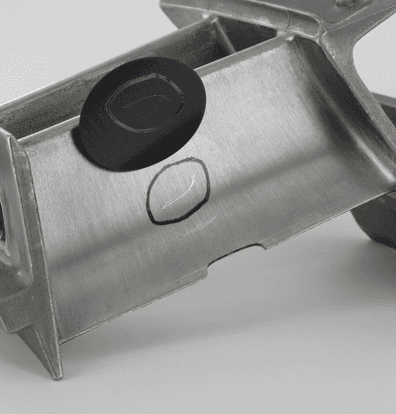
Impression/Replica Testing offers a practical solution when direct measurement of surface features is impossible due to access constraints, part geometry, or environmental conditions.
This technique involves applying a specialized molding compound (such as Plastiform products) directly onto a surface.
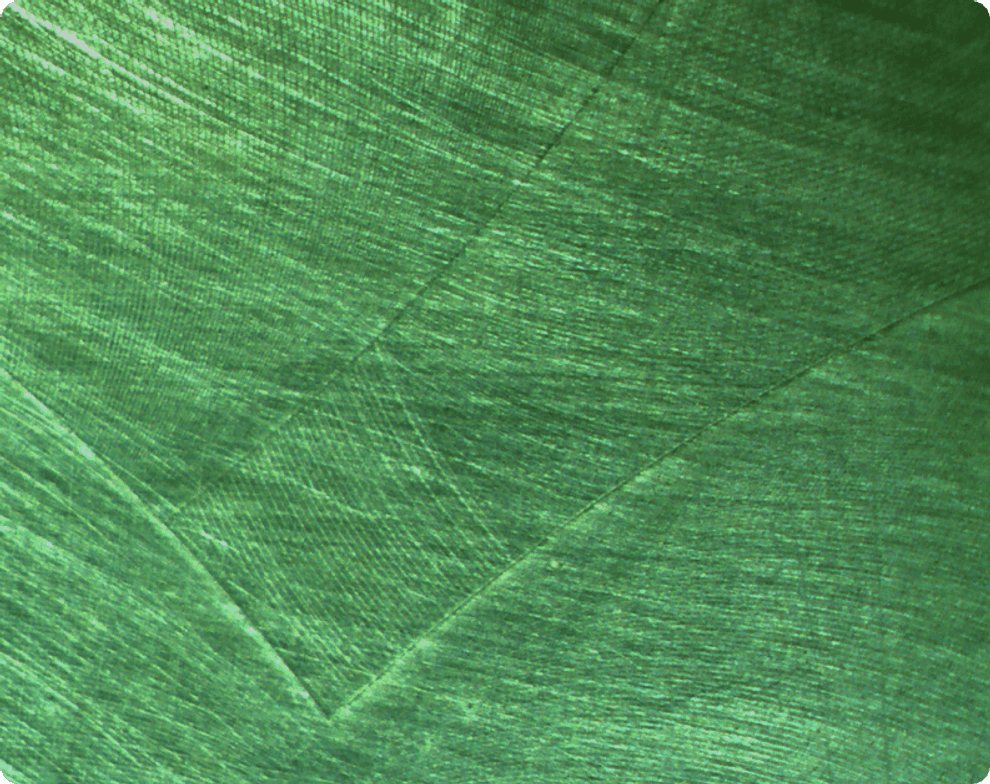
The material cures rapidly and captures an exact negative impression of every surface detail with micron level precision.
Once removed, the replica can be transported to a laboratory or inspection station for detailed analysis using standard metrology equipment like optical comparators, profilometers, or coordinate measuring machines (CMMs).
A major advantage of impression replica testing is documentation.
Each replica serves as a permanent, physical record of the surface condition at a specific point in time, enabling comparative analysis during future inspections to track degradation trends.
Acoustic Emission Testing (AE)
Most NDT methods differ from Acoustic Emission because they are active (they send energy into the part).
AE testing is passive. It “listens” for the release of energy from a material while it is under stress. When a crack forms or grows, it generates a distinct mechanical vibration or stress wave.
Technicians attach highly sensitive piezoelectric sensors to the surface to detect these waves.
This method is particularly valuable for structural health monitoring in real-time.
It can tell you if a defect is actively growing during a proof test, rather than just showing you where the static cracks are located.
Infrared and Thermal Testing (IR)
Infrared testing relies on the principle that heat flows differently through solid materials than it does through air gaps or flaws.
By using thermal imaging cameras, you can map surface temperature patterns to find anomalies. A subsurface defect acts as an insulator, causing a measurable temperature difference (Delta T) on the surface.
This technique is widely used for electrical inspections to find overheating components before they fail.
It is also one of the effective defect detection techniques for aerospace composites, where it helps identify delamination or water ingress without touching the part.
It helps you visualize energy loss and thermal-induced deformations instantly.
Guided Wave Testing (GW)
Standard ultrasonic testing inspects the area directly under the probe. Guided Wave Testing is different because it sends low-frequency ultrasonic waves that travel along the length of the structure, using the pipe wall itself as a waveguide.
This allows the signal to travel for tens of meters in both directions.
This is extremely useful for inspecting long pipelines without needing to access every inch of the surface.
A huge advantage of GW is that you often do not need to remove insulation or protective coatings to run the test.
It detects cross-sectional changes over long distances efficiently.
Leak Testing (LT)
Leak testing encompasses a family of methods used for detecting breaches in sealed or pressurized systems.
It confirms that a container prevents fluid or gas from escaping. The complexity ranges from simple bubble leak tests (soap solution) to highly sensitive mass spectrometer tests.
For critical applications like gas tanks, refrigeration systems, or chemical basins, technicians often use halogen diode tests or pressure change tests to measure pressure decay over time.
This ensures hermetic seals are intact and the system can safely hold hazardous materials under operating conditions.
Industries Using NDT
These tests do not belong to a single niche. If a part failure is dangerous, expensive, or legally risky, you will likely find Non-Destructive Testing (NDT) involved.
According to the Bureau of Labor Statistics (BLS), the largest employers of NDT technicians are architectural and engineering services, machinery manufacturing, and transportation equipment manufacturing.
But the application expands well beyond those statistics.
We see heavy usage in scientific research and development and computer product manufacturing, alongside heavy industries like mining, marine, and power generation.
In every case, the goal remains the same: determining if a component is safe to use without having to destroy it to find out.
Aerospace and Aviation
In the aerospace industry, there is effectively no margin for error.
A component failure at 30,000 feet often has catastrophic consequences, unlike a machine breaking down on a factory floor. This high stakes environment drives huge demand for rigorous defect detection techniques.
Consider turbine blades in a jet engine.
These parts must operate under extreme temperatures and immense pressure while spinning at high speeds.
Engineers use sensitive techniques like Ultrasonic Testing (UT) and Radiographic Testing (RT) to inspect these blades for microscopic material inconsistencies or cracks.
Even a tiny flaw that is invisible to the eye can propagate into a major fracture under these conditions.
By catching these early, we ensure the structural integrity of the aircraft remains intact throughout its lifespan.
Oil and Gas
This industry manages massive infrastructure that often carries hazardous materials.
A leak in a pipeline carrying oil or nuclear elements is not just an operational nuisance. It is an environmental disaster and a huge financial liability.
To prevent this, technicians rely on NDT methods to monitor the condition of standard pipes and storage tanks.
One common technique here is magnetic flux leakage (MFL).
This allows inspectors to scan steel structures to detect early signs of corrosion or pitting that are hidden inside the pipe walls.
Regular inspection ensures that asset integrity is maintained long before a wall becomes too thin to handle the internal pressure, preventing accidents before they happen.
Impression testing is very popular also to perform inspections on API threads (even on site for wear control).
Manufacturing
In general manufacturing, the focus shifts slightly toward balancing quality control with cost-effectiveness.
Manufacturers need to verify that castings, forgings, and machined components meet specifications without scrapping valuable inventory for testing.
Weld verification is arguably the most common application here. If a weld has lack of fusion, porosity, or internal cracking, the entire assembly might fail under load.
NDT techniques allow quality assurance teams to “see” inside the joint and verify it is solid. This creates a much more accurate testing process compared to random sampling destructive tests.
Probability of Detection and Reliability
When you evaluate a measurement system, you rarely ask if it “works” or “doesn’t work”. You ask about its statistical performance.
NDT is no different.
The industry standard for evaluating effectiveness is the Probability of Detection (POD). This metric plots the likelihood of finding a defect against the flaw size.
It turns out that detection is almost never binary. As the defect size increases, your probability of finding it goes up, but it rarely hits 100% immediately.
For the metrology engineers reading this, you can think of POD as the NDT analog to a measurement system’s capability index.
It quantifies the system’s reliability under real-world conditions rather than just theoretical bests.
This distinction is critical because environmental factors introduce massive variables.
This is why relying on nominal sensitivity, simply stating a system “can find 1 mm cracks” is dangerous.
Without a rigorous, quantitative POD analysis, you are guessing at your actual safety margins involving risk inputs like false call rates and detection thresholds.
Personnel Certification and Standards
The tools are only as effective as the person using them.
You can buy the most expensive phased array ultrasonic system on the market, but if the operator doesn’t understand the physics of sound waves or the limitations of the probe, the data is useless.
This is why successful NDT application depends heavily on personnel training, experience, and integrity.
It is not just about knowing which button to push, it is about understanding equipment calibration, environmental influences, and the specific detection capability of the method you are using.
In many industrial sectors, proper certification isn’t optional.
It is enforced by law or applied codes.
The current global reference for this competence is ISO 9712:2021.
This standard ensures that anyone signing off on a safety critical inspection has proven their ability to interpret data correctly.
Without this verification, we are essentially guessing, and in fields like aerospace or nuclear power, guessing is not an option.
Certification Levels
To keep things organized, the industry breaks competence down into three distinct tiers.
It turns out that having a clear hierarchy helps maintain quality control across complex projects.
Level 1 is where most technicians start. At this stage, you are qualified to perform specific calibrations and run tests, but you must work under close supervision. You follow strict written instructions and record the data, but you do not interpret whether a part passes or fails.
Level 2 is the operational sweet spot. These are generally engineers or experienced technicians who can set up the equipment, calibrate it without help, and conduct the full inspection. Most importantly, a Level 2 is authorized to interpret the results and sign off on whether a component meets the required standards.
Level 3 represents the highest level of expertise. A Level 3 engineer establishes the techniques and procedures used by everyone else. They interpret complex codes, design the inspection process, and often direct the NDT laboratories. They are also the ones responsible for training and examining Level 1 and Level 2 personnel.
Conclusion
We have covered a lot of ground in this guide.
At its core, Non-Destructive Testing is the art and science of evaluating materials without causing any damage.
Whether you are using ultrasonic waves to listen for echoes or magnetic particles to reveal invisible cracks, the goal remains the same: ensuring the structural integrity of a component without turning it into scrap metal during the process.
This approach balances three needs that often fight against each other in manufacturing: ensuring public safety, verifying product quality, and maintaining cost efficiency.
By catching defects early (often before a part even leaves the factory) NDT professionals prevent catastrophic accidents and expensive recalls.
They are the reason we can trust that an aircraft wing will hold up during turbulence or that a gas pipeline will remain sealed under pressure.
It is also important to remember that this field is evolving rapidly.
We are moving away from simple “looks good to me” inspections toward NDT 4.0. With the rise of digital sensors and automated data analytics, we are treating inspection results as hard measurement data. As we discussed, modern AI-driven methods are already hitting defect classification accuracies above 95%. T
his shift means metrology engineers and QA teams need to treat NDT data with the same rigor as dimensional measurements.
However, even the best technology requires skilled hands.
Reliable inspection depends heavily on proper training and personnel certification.
Standards like ISO 9712 exist to ensure that the person reading the screen understands the physics behind the squiggly lines.
If you are looking to implement these methods, investing in qualified staff is just as important as buying the right transducer or X-ray source.
There is a massive world of invisible physics keeping our infrastructure safe.
Whether you are just starting to explore defect detection techniques or you are refining a complex inspection plan, the key is to stay curious and precise.
Frequently Asked Question
What is non-destructive testing and why is it used?
Non-destructive testing (NDT) denotes analysis techniques used to evaluate materials or components without causing damage. You use these methods to identify defects like cracks or voids while keeping the product usable. It allows you to maintain safety standards and product quality without destroying the items you are inspecting.
How does non-destructive testing differ from destructive testing?
Destructive testing pushes a material until it fails to understand its physical limits. This renders the sample useless. In contrast, non-destructive testing inspects the item for flaws without altering its physical state. You can still use the component in your machinery or supply chain after an NDT inspection is finished.
What are the most common non-destructive testing methods?
The six primary methods are visual testing, ultrasonic testing, radiographic testing, magnetic particle testing, liquid penetrant testing, and eddy current testing. Each technique relies on specific physical principles like sound waves or magnetism to detect surface or subsurface flaws. You select the method based on the material type and the defects you need to find.
Can you perform non-destructive testing on any material?
You can apply NDT to almost any material, but specific methods have limitations. For instance, magnetic particle testing only works on ferromagnetic metals like iron or steel. Liquid penetrant testing is effective on non-porous materials. You must match the technique to the material properties to get accurate results.
What industries rely most heavily on non-destructive testing?
Industries where safety is the top priority use these inspections daily. This includes aerospace, oil and gas, automotive, power generation, and construction. You will find NDT technicians inspecting pipelines, aircraft engine components, and bridge structures to prevent accidents and ensure regulatory compliance.
How is the reliability of an NDT method measured?
Engineers evaluate reliability using the Probability of Detection (POD) metric. This statistical measurement indicates how likely a specific technique is to find a flaw of a certain size. High reliability requires validated procedures and calibrated equipment to ensure you do not miss defects that could compromise structural integrity.
What defines NDT 4.0 in modern inspection processes?
NDT 4.0 involves integrating digital sensors, automated data acquisition, and advanced analytics into the inspection workflow. Instead of just manual readings, you use connected systems that store data for trend analysis. This shift allows for predictive maintenance and better traceability across the entire lifespan of a product.
What are the certification levels for NDT personnel?
Certification typically follows a three-tier system defined by standards like ISO 9712. Level 1 technicians perform specific tests under supervision. Level 2 personnel can set up equipment, interpret results, and verify settings. Level 3 engineers establish techniques, write procedures, and oversee the entire inspection program.
How does computed tomography aid additive manufacturing verification?
Computed tomography (CT) provides a comprehensive view of internal structures in complex 3D-printed parts. Unlike mass production methods that often use surface tests, additive manufacturing creates internal geometries that can hide voids. CT scans allow you to verify dimensional accuracy and material density without cutting the printed component open.