
Last updated:
Visual Testing (VT) is the examination of material surfaces and workmanship using the human eye, often aided by optical instruments, to identify discontinuities without damaging the component.
It is the most fundamental non-destructive testing method used in mechanical engineering today.
I used to treat visual checks as an afterthought. To me, “inspection” meant using an instrument like a caliper or a roughness tester. I assumed that looking at a part with just my eyes was too subjective to be useful.
Visual Testing is the first line of defense in quality control.
When performed correctly, it detects the vast majority of surface defect detection anomalies, including pitting, corrosion, joint misalignment, and foreign material contamination.
In exigent fields like oil and gas, aerospace, and structural construction, a properly executed visual test is often the most cost efficient way of identifying a defect.
And that’s because you don’t need a complete battery of tests if you spot a pink elephant in the hallway, right?
In this post, I’ll share exactly how to implement a structured visual testing program.
We will cover the fundamentals of direct and remote viewing, the equipment you need (from simple mirrors to digital microscopes), and the procedures required to meet international standards. We will also discuss how to document your findings so they are traceable and audit-ready.
Let’s take a closer look at this awesome testing strategy!
Table of Contents
What is Visual Testing?
Visual Testing (VT) is a non-destructive testing method that examines material surfaces and components using direct observation or optical instruments to detect surface discontinuities, cracks, corrosion, and defects without damaging the part. It serves as the primary screening method in quality control and NDT programs across manufacturing, aerospace, and oil & gas industries.
Within the quality assurance field, we classify VT under non-destructive testing methods (NDT) because the process does not alter, stress, or damage the inspected part.
It is considered the first line of defense in inspection programs.
Before you break out complex radiographic or ultrasonic equipment, you simply look at the part to spot obvious issues.
While it might sound very simple, Visual Testing is a rigorous process capable of detecting a wide range of flaws.
A skilled inspector can identify surface discontinuities like cracks or porosity, dimensional variations, and structural anomalies.
It is also the primary method for catching coating defects and assembly errors before they cause problems downstream.
Direct Visual Testing
Direct visual testing happens when the inspector can place their eye within a specific distance of the test surface.
Most standards, such as ASME Section V, require the eye to be within 24 inches (600 mm) of the surface at an angle not less than 30 degrees. This ensures you are close enough to actually see the defect rather than guessing from a distance.
To perform this effectively, you need adequate illumination.
The industry standard typically demands a minimum light intensity of 1000 lux (roughly equivalent to a brightly lit office or a specialized inspection booth).
While the “unaided eye” is the main tool, inspectors frequently use magnifying lenses (2x–10x), inspection mirrors, and welding gauges to verify surface preparation and final assembly dimensions.
Remote Visual Inspection
When you cannot physically access the component, such as the interior of a small diameter pipe or a hazardous tank, you use Remote Visual Inspection (RVI).
This method relies on optical instruments or a 3rd party medium to transmit images from the test area to the inspector’s eye or a digital display.
At Plastiform for exemple, we provide products dedicated to this application.
This is an interesting technique for performing checking internal pipe inspection and confined space inspection safety.
Modern RVI relies on multiple types of measurements.
We use video borescopes with articulating tips, flexible fiberscopes, and even robotic crawlers or drones for large structures.
These systems must provide high image resolution and recording capabilities.
This documentation is vital because, unlike direct viewing, RVI often requires a second opinion or historical comparison to track how a defect, like corrosion or wear patterns, evolves over time.

Note: Lighting is often the biggest variable in Remote Visual Inspection. A high-resolution camera is useless if the integrated LED light source casts shadows that hide the root of the weld or the bottom of a pit.
Why do we use Visual Testing?
You might assume that complex methods like X-ray or ultrasound are the most accurate way of performing a quality control.
But when you spot a bull in a china shop, you don’t need to make a complete battery of test on the bull to know there is a massive problem that need to be solved.
Visual Testing (VT) is actually the first check to be done in any inspection program.
The reason is simple: it offers immediate results at a significantly lower cost than any other technique.
You do not need expensive specialized consumables like penetrants or magnetic powders, and it works effectively on virtually all materials, from carbon steel to thermoplastics.
It’s a high efficiency filter.
It acts as a screening method before you employ more capital intensive non-destructive testing methods.
If you spot a visible crack or severe surface defect, you can reject the part immediately.
There is no point in wasting time and budget setting up an X-ray shot for a defect you can already see with your naked eye. T
his makes the entire manufacturing workflow faster and leaner.
Another huge advantage is that it is completely non invasive.
You can perform it during manufacturing, while a welder is laying a bead (in-process), or during routine shutdown inspections. It does not require evacuating the area for radiation safety or stripping complex coatings just to get a reading.
It is important to remember that Visual Testing is highly operator dependent.
While the equipment is simple, the results rely heavily on the inspector’s experience, visual acuity, and the quality of the lighting conditions.
However, there are limitations you must respect.
The most obvious is surface access. You must have a clear line of sight to the inspection area, either directly or via remote visual inspection tools.
Additionally, visual testing is strictly limited to surface and near surface indications. It cannot detect internal porosity or deep subsurface cracks.
For those, you will always need to switch to volumetric methods.
Visual Testing Equipment: Essential Tools & Instruments
Many people assume visual testing is just “looking at the part”.
However, accurate inspection results require specific tools to standardize how the human eye perceives the object.
You cannot rely on ambient light or unmeasured estimation to find flaws. The equipment you choose depends heavily on access constraints, whether you can touch the surface or need to see inside a narrow pipe, and the specific documentation requirements of your quality program.
Basic Inspection Aids
For Direct Visual Testing, where your eye is close to the surface, you need aids to verify geometry and clarify details.
Magnifiers (typically ranging from 2x to 10x power) and adjustable inspection mirrors allow you to check behind stiffeners or verify surface cleanliness in tight spots.
Lighting is very important here.
Standards like ISO 17637 typically require a minimum light intensity (illuminance) of 350 lux at the inspection surface, though critical applications following ASME Section V often demand 1000 lux to ensure optimal defect visibility.
Always check your light source angle. Illuminating a surface at a grazing angle (5 to 45 degrees) helps highlight texture and cracks by creating shadows, whereas direct lighting might wash them out.
You also need mechanical tools to quantify what you see. Cambridge gauges, fillet weld gauges, and linear scales convert a subjective observation (“that looks deep”) into a concrete measurement.
For surface defect detection, inspectors often use visual comparators (physical plates with known roughness values) to confirm surface finish compliance quickly.
Optical Instruments
When you cannot get your eye within 600 mm of the test surface, you use Remote Visual Inspection (RVI) tools.
The most common tool here is the borescope.
A rigid borescope uses a series of glass lenses to transmit the image. Rigid scopes offer the highest image clarity, but they are limited to straight-line access.
If the path to the inspection area is non linear, you must use a flexible fiberscope or a video borescope.
Modern video borescopes have a camera chip at the tip and display the image on a handheld screen. These are powerful because they often include stereo measurement capabilities.
This allows you to measure the length and depth of a crack directly on the screen using cursors, providing immediate data for your inspection report without needing to access the part physically.
Advanced RVI Systems
For large scale assets or hazardous environments, handheld scopes are insufficient.
Robotic crawlers are used to travel down long pipelines, carrying cameras and sensors to detect corrosion or blockages.
In the aerospace and energy sectors, inspection drones are becoming standard for examining high structures or large storage tanks. These systems remove the need for expensive scaffolding and keep the inspector safe on the ground.
These advanced systems often utilize Pan-Tilt-Zoom (PTZ) cameras with high-definition sensors.
This enables you to zoom in on a suspect indication from meters away while maintaining high resolution.
Many systems also integrate GPS tagging or 3D mapping, ensuring that every photo or video frame is tied to a specific location on the asset, which is vital for long term structural health monitoring.
Visual Testing for Surface Defect Detection
Finding a flaw is satisfying, but correctly identifying it is where the real skill lies.
Surface defect detection works by identifying discontinuities (breaks in the material’s continuity) and determining if they compromise the part.
You really need to understand defect morphology (the shape and structure) to distinguish between a harmless cosmetic scratch and a dangerous stress corrosion crack.
Common Defect Types
You will typically encounter four main categories of surface indications during an inspection.
The first group covers mechanical defects caused by physical force, such as cracks, gouges, and wear patterns.
These are often sharp and linear.
The second group involves corrosion, which manifests as pitting, uniform rust, or crevice corrosion.
In manufacturing environments, you usually see process defects.
In welding, this includes porosity (gas pockets), undercut (grooves at the weld toe), and incomplete fusion. Finally, look out for coating defects like blistering or peeling, which indicate the protective layer has failed.
Defect Characterization
Once you spot an anomaly, you have to measure it.
You need to record the length, width, and depth using tools like pit depth gauges or optical comparators.
The morphology tells you the severity.
For instance, a sharp edged discontinuity acts as a stress riser and is far more dangerous than a rounded one.
It is also important to differentiate between relevant indications and non relevant indications.
A machining mark or a fabrication scratch might look like a crack under poor lighting, but it does not affect structural integrity.
Your job is to map these defects effectively using a reference grid so repairs can be targeted precisely.
Surface Replication for Enhanced Detection
When you inspect complex geometries or confined spaces, getting your eye close enough to verify a defect is often impossible.
Even with a borescope, you might struggle to confirm if that indication is a harmless scratch or a dangerous crack.
This is where surface replication becomes invaluable.
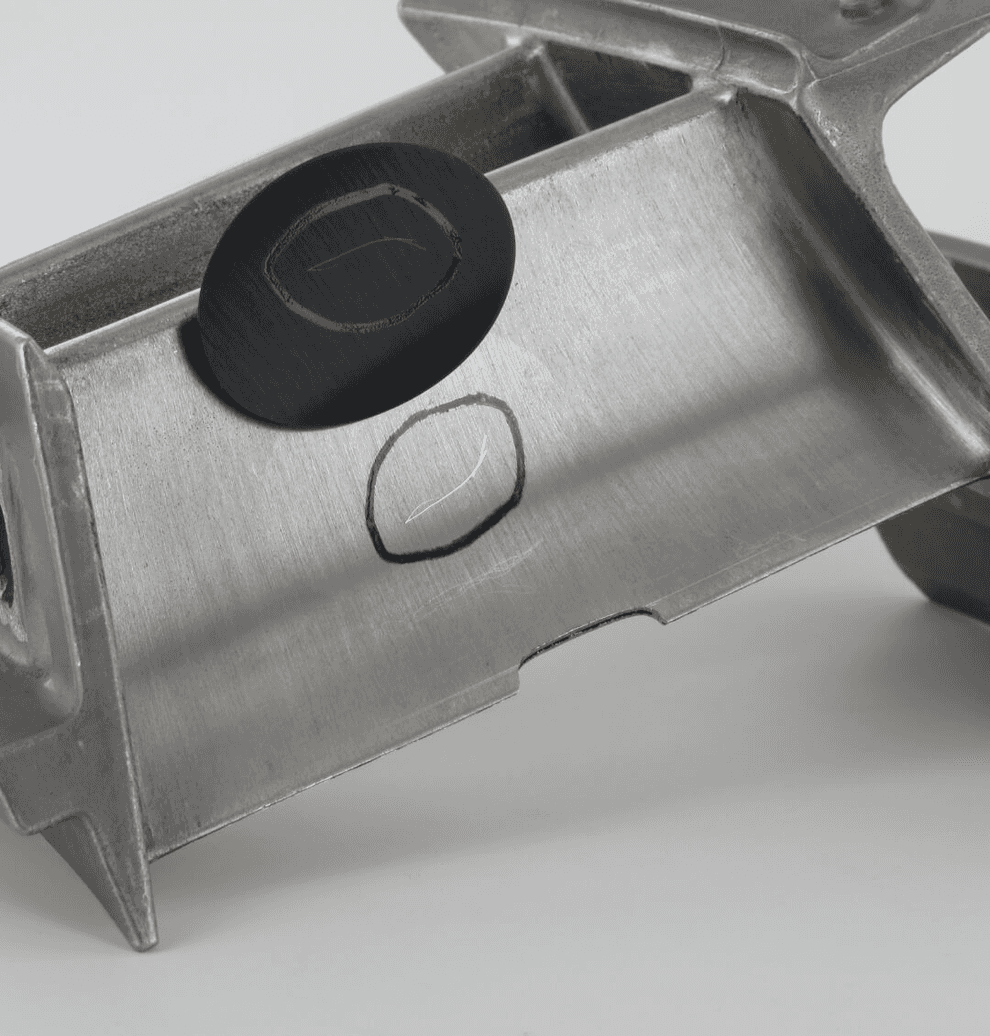
Plastiform’s F30 Visual is specifically engineered for this exact challenge.
You apply a thin layer of the material directly onto the suspect surface. The compound conforms perfectly to the surface topology, capturing even microscopic details. Once cured, you peel it off and examine it under proper lighting conditions at your workbench.
The real advantage is the black glowing finish.
Surface discontinuities that blend into a metallic background suddenly become highly visible against the contrasting replica.
You can now use any optical device from a simple magnifying glass to a digital microscope to measure and document the defect without the access constraints of the original location.
This method is particularly effective for weld inspection in tight spaces. Instead of contorting yourself to verify a root pass inside a pipe, you take a replica and bring the surface to you. You can archive these replicas as permanent records, providing traceability that a photograph alone cannot match.
It’s non-destructive, leaves no residue, and works on virtually any material.
Whether you’re dealing with internal valve surfaces, elevated piping, or complex casting geometries, surface replication transforms an impossible direct inspection into a controlled laboratory examination.
The technique integrates seamlessly with your existing Visual Testing procedures. You still follow the same acceptance criteria and documentation requirements.
You’ve simply extended your inspection capability into areas where traditional direct or remote viewing falls short.
For critical components where you need absolute certainty, combining standard VT with surface replication gives you the best of both worlds: immediate screening followed by detailed characterization.
Weld Inspection Procedures
Visual examination is not just a “nice to have” step in fabrication, it is a mandatory requirement.
Almost every major fabrication code (whether it is ASME BPVC or AWS D1.1, or any other) requires visual testing for 100% of welded joints.
Most weld defects originate from poor setup or technique, meaning you can often catch them long before the weld is finished.
Effective inspection happens in three distinct phases: before, during, and after welding.
Pre-Weld Inspection
You can prevent the majority of weld defects before an arc is even struck.
The pre-weld inspection is where you verify that the joint geometry matches the Welding Procedure Specification (WPS).
You need to measure the bevel angle, root face, and root opening using precise weld gauges. If the fit-up is too wide or the misalignment (hi-low) is out of tolerance, a sound weld is physically impossible.
You must also ensure the base metal is clean (free of oil, rust, or paint) and verify that the preheat temperature meets the material requirements.
In-Process Inspection
Once welding starts, you cannot just walk away until it is finished.
In-process inspection involves monitoring the weld as individual layers are deposited.
You are looking for complete slag removal between passes and ensuring the interpass temperature stays within the specified limits.
This is your best chance to spot incomplete fusion or cracks in the root pass (the most sensitive part of the joint).
If the procedure calls for welding from both sides, verifying proper back gouging to sound metal on the second side is essential to prevent lack of penetration.
Post-Weld Inspection
After the metal cools, the post-weld inspection verifies the final product against the code’s acceptance criteria.
You aren’t just looking for cracks; you need to measure the actual weld size (leg length or throat) using a fillet weld gauge. You must check for surface discontinuities like undercut, overlap, or excessive reinforcement.
The weld profile should be visibly smooth and transition gradually into the base metal. If you find surface porosity or accidental arc strikes outside the weld zone, these must be marked clearly for repair.
Applicable Standards and Codes
Visual testing has a reputation for being somewhat subjective.
If I say a scratch is “too deep” but you say it’s “minor”, who wins?
This is why performing inspections according to recognized standards is non-negotiable. These documents strip away the ambiguity, providing clear acceptance criteria so that results are repeatable, regardless of who is holding the flashlight.
Depending on your industry, you will likely work with one of the major governing bodies.
In the United States, ASME (American Society of Mechanical Engineers) and AWS (American Welding Society) dominate the pressure vessel and structural sectors.
For international projects, ISO (International Organization for Standardization) provides global consistency, while API (American Petroleum Institute) sets the rules for the oil and gas sector.
Additionally, ASTM (American Society for Testing and Materials) defines the specific test methods used across these industries.
Key VT Standards
Let’s look at the specific documents you will encounter most often.
For pressure equipment, ASME BPVC Section V Article 9 lays out the strict requirements for procedure qualification and execution.
It dictates exactly how much light you need and the maximum angle you can view from. If you are dealing with structural steel, AWS D1.1 Clause 6 is your reference for inspection rules, defining what counts as a rejectable weld discontinuity.
Internationally, ISO 17637 covers the non-destructive testing of welds, specifically detailing the visual testing of fusion-welded joints.
For in-service equipment like pipes and storage tanks, standards like API 510 and API 570 rely heavily on visual checks to monitor corrosion rates and wall thinning.
Finally, standard practices like ASTM E1417 often mandate a complete visual check as a prerequisite before moving on to more sensitive methods like penetrant testing.
Personnel Qualification Requirements
Visual testing feels simple just looking, right?
But here’s the catch: it is inherently subjective.
Because the human eye is the primary instrument, the reliability of the test depends entirely on the competence of the inspector.
This is why standards organizations enforce strict qualification requirements to ensure that “looking” actually counts as a valid inspection.
Most industrial programs follow the guidelines set by the ASNT SNT-TC-1A recommended practice or the ISO 9712 standard.
These frameworks generally divide personnel into three distinct tiers based on responsibility:
- Level I: Can perform specific calibrations and tests under supervision but cannot interpret results or sign off on reports.
- Level II: The standard “inspector” role. They can set up equipment, interpret results against codes, and report findings independently.
- Level III: The expert who develops written procedures, trains Level I/II staff, and administers qualification exams.
You also need to prove you can physically see the defects.
Candidates must pass a visual acuity test annually, typically reading a standard Jaeger J1 or J2 chart at a distance of not less than 12 inches (300 mm).
You also need to pass a color contrast differentiation test. This ensures you can distinguish between the colors used to identify materials or interpret color coded indications often found in determining weld quality.
Getting certified isn’t just about reading a book. For a Level II certification in Visual Testing, you typically need roughly 24 hours of formal classroom training and 210 hours of documented practical experience.
Finally, certifications come in two flavors.
Employer-based certification (common in SNT-TC-1A) means your specific company certifies you for their procedures.
If you leave, you lose the certification.
In contrast, 3rd party certification like the ASNT Central Certification Program (ACCP) is portable and recognized across the industry, proving your skills meet a global standard regardless of your employer.
How to Implement a Visual Testing Program
Implementing a Visual Testing program might seem straightforward.
After all, you are just looking at parts, it can’t be that heavy, right?
But achieving repeatable results is complex. A formal implementation moves beyond casual observation to a structured, justifiable process.
This requires synchronising three specific elements: written procedures, qualified personnel, and the right equipment.
Without this structure, two different inspectors will likely give you two different results for the same component.
Follow these 4 steps to implement a Visual Testing program:
- Develop Written Procedures – Create documented inspection practices with specific acceptance criteria, lighting requirements (1000 lux minimum), and viewing angles per ASME Section V or ISO 17637 standards.
- Prepare the Inspection Area – Clean surfaces to remove grease, scale, and coatings; verify environmental conditions including minimum 1000 lux lighting and safe access to test surfaces.
- Perform the Examination – Use systematic scanning techniques with 50% overlap between inspection areas; maintain eye position within 600mm (24 inches) at 30-degree minimum angle to surface.
- Document and Report Results – Record inspector identity, date, procedure revision, defect type, location, and dimensions; include high-resolution images and conformance statements referencing applicable codes.
Develop Written Procedures
You cannot perform consistent inspections based on memory alone.
The first step is creating a written practice or procedure that dictates exactly how the examination occurs using standardised criteria.
This document must list the scope of the inspection, the equipment required (such as magnifiers or gauges), and the specific standards you are referencing, like ASME BPVC Section V or ISO 17637.
Your procedure needs to define the acceptance criteria with zero ambiguity.
For example, instead of saying “check for scratches”, specify that “linear indications longer than 1 mm are rejectable”.
You must also define the viewing conditions, including the required angle of observation and lighting intensity. This removes subjectivity from the process and gives your team a clear “recipe” to follow every time.
One common pitfall is vague criteria. Always quantify limits where possible.
If a code allows undercut up to 0.8 mm, your procedure must explicitly state that measuring tool verification is required for visual indications nearing that depth.
Prepare the Inspection Area
A visual test is only as good as your view of the test surface.
Before you pick up a magnifier, you must clean the component to remove grease, scale, spatter, or protective coatings that could mask surface defects.
Even a small layer of dirt can hide a hairline crack. Common cleaning methods include solvent cleaning or wire brushing, but be careful not to use mechanical methods that might smear metal over a defect opening.
Once the part is clean, you must verify the environmental conditions.
Lighting is a critical variable here.
Most codes, including ISO 9712, require a minimum light intensity of 1000 Lux (approximately 100 foot-candles) at the inspection surface for detecting fine details.
You also need to verify access. If you are inspecting a confined space, verify that safety permits are in place and that you have sufficient stand-off distance to view the area comfortably.
Perform the Examination
When you start the inspection, use a systematic scanning technique.
Do not just glance at the part randomly.
Scan the surface in a structured grid or linear pattern, making sure to overlap adjacent areas by at least 50% to prevent missed spots.
You need to maintain specific geometric relationships between your eye and the surface. Standard practice requires your eye to be within 600 mm (24 inches) of the surface and at an angle of roughly 30 degrees or more.
During the scan, you will often switch between unaided viewing (using just your eyes) and aided viewing (using tools like rigid borescopes or inspection mirrors).
If you identify a potential anomaly, stop and characterise it immediately. Use mechanical gauges or comparators to measure the dimensions.
Never guess the size of a defect; reliable quality assurance depends on verified measurements.
Document and Report Results
The final step is establishing traceability through documentation.
A visual testing report must include more than just a “Pass” or “Fail” checkbox.
You need to record the inspector’s identity, the date of inspection, and the specific procedure revision used. When you find relevant indications, record their type, exact location, and dimensions (length, width, and depth if measurable).
Modern remote visual inspection tools make this easier by capturing high resolution images or video directly during the scan.
If you are doing direct observation, hand sketches or photos with a reference scale are good alternatives.
Always include a definitive conformance statement referencing the applicable code (e.g., “Acceptable per AWS D1.1 Table 6.1“).
This documentation protects you during audits and provides a historical record of the component’s condition.
Visual Testing vs Other NDT Methods
You might wonder why we need expensive technology if we have eyes.
The reality is that Visual Testing is the first thing we try, but it is rarely the only thing involved.
In the hierarchy of non-destructive testing methods, VT serves a specific role: it is a filter.
It catches the obvious issues:
- Surface cracks – Major fractures and hairline defects visible on component surfaces
- Corrosion damage – Pitting, rust, and material degradation from chemical exposure
- Dimensional errors – Out-of-tolerance measurements and geometric misalignment
- Weld discontinuities – Porosity, undercut, and incomplete fusion in welded joints
That’s so you don’t waste time and money using advanced methods on a part that is already visibly defective.
Think of it like painting a house: you wouldn’t apply the expensive topcoat before fixing the holes in the drywall.
Similarly, you perform VT before methods like Radiographic Testing or Ultrasonic Testing.
If a weld has visible surface porosity, you reject it immediately via VT. There is no point in setting up an X-ray source, which costs significantly more and introduces safety hazards, to find a defect you could see with a flashlight.
However, the human eye has hard limits.
VT is strictly limited to surface defect detection. It cannot see through steel or concrete.
For internal discontinuities, such as lack of fusion inside a thick weld or lamination inside a plate, you must use volumetric methods like UT or RT.
These methods use sound waves or radiation to penetrate the material, revealing data that is physically impossible for VT to capture, even with advanced remote visual inspection cameras.
Even on the surface, VT can miss things.
Tight cracks often remain invisible to the naked eye because they don’t reflect enough light.
To catch these, we pair VT with Liquid Penetrant Testing or Magnetic Particle Testing.
These methods act as “contrast enhancers,” forcing the defect to stand out against the background.
For conductive materials, you might use electromagnetic methods to find these elusive surface flaws.
The choice comes down to cost vs capability.
Visual Testing is fast, requires minimal equipment, and costs very little per inspection hour.
But it is subjective and limited to the surface.
Advanced methods provide quantitative data and depth, but they require highly trained technicians and expensive hardware.
Most effective quality assurance programs use them in tandem: VT filters and supplementary methods verify the rest.
Visual Inspection Challenges and Solutions
In practice, getting consistent results is very hard.
Environmental chaos and human limitations often conspire to hide defects right in front of you.
Improving your inspection reliability requires acknowledging these hurdles upfront. If you do not plan for them, your data becomes noisy and unreliable.
Access Limitations
The most dangerous defects often hide in the hardest to reach places.
Confined spaces, internal valve surfaces, or elevated piping often make direct line of sight impossible.
If an inspector cannot get their eye within 600mm (24 inches) of the surface, the inspection typically fails code requirements.
Trying to force physical access can also introduce significant safety risks to your team.
The solution lies in Remote Visual Inspection tools.
Using video borescopes, robotic crawlers, or even drones allows you to bridge that gap without endangering personnel. For new projects, you should advocate for design for inspection.
Adding view ports or access hatches during the design phase saves massive headaches later.
Environmental Factors
You cannot inspect what you cannot clearly see.
Poor lighting, heavy grease, or rust scale will mask surface indications like hairline cracks. Even glare from polished metal can blind an inspector to a subtle defect.
Temperature extremes also play a role.
High heat creates heat shimmer that distorts visual data and damages sensitive optical equipment.
To fix this, treat surface preparation as a mandatory step.
Use wire brushing or solvent cleaning to remove contaminants before looking. Always verify your lighting meets the minimum 1000 lux requirement using a light meter.
If conditions are hostile, schedule work during shutdown windows or use environmental controls like temporary shelters to stabilize the area.
Inspector Variability
Humans are not machines.
Inspector fatigue, distraction, and varying experience levels inevitably lead to different results for the same part.
This subjectivity is the primary weakness of visual testing. One person might reject a weld for undercut, while another accepts it based on a slightly different viewing angle or interpretation.
You can stabilize this by using standardized procedures that leave no room for guessing.
Provide reference photographs or physical surface comparators so inspectors compare defects against a known standard, not just their memory.
Implement strict rotation schedules to prevent eye fatigue and enforce periodic vision acuity testing (usually Jaeger J1 or J2) to verify physical capability.
Conclusion
Visual testing might seem deceptively simple.
After all, strict observation sounds easy enough, doesn’t it ?
It is actually the foundation of mechanical integrity. It acts as the primary gatekeeper, catching surface defects, misalignment, and corrosion long before you need to break out expensive ultrasonic or radiographic equipment.
This method only works if you treat it with the same rigor and respect as any other NDT technique.
Achieving consistency relies heavily on having qualified personnel. Simply having “good eyesight” isn’t enough; your inspectors need to understand defect morphology and follow strict written procedures aligned with standards like ISO 17637 or ASME Section V.
Whether you are using a simple welding gauge to check reinforcement or a sophisticated video borescope for remote visual inspection, the tools are only as effective as the training behind them.
A certified Level II technician knows exactly what to look for, whereas an untrained eye often just sees metal.
Remember that preparation is everything.
If you skip surface cleaning or try to inspect with insufficient lighting (typically anything under 1000 lux), you are essentially flying blind.
Systematic execution (scanning with proper overlap) ensures you don’t miss that one critical indication hiding in the shadows. You also need to back up your findings with solid documentation.
A clear inspection report featuring high resolution photos and measurement data transforms a subjective opinion into an objective, traceable record.
While VT is powerful, it does have physical limits.
It is best used as a screening tool alongside complementary methods like Eddy Current Testing or Magnetic Particle Testing to catch tight cracks or subsurface issues that light alone cannot reveal. Integrating these methods gives you complete coverage.
The biggest takeaway here is about return on investment. Spending time on developing a solid inspection protocol and money on decent optical aids isn’t just an expense.
It is quality insurance.
Detecting a 0.5 mm crack visually during manufacturing costs pennies to fix compared to a catastrophic failure in the field.
So, don’t underestimate the power of direct observation. Go grab your flashlight and magnifier, verify your acceptance criteria, and start inspecting with intent!
Frequently Asked Questions
What is the main purpose of visual testing in mechanical engineering?
Visual testing allows you to assess the surface condition of a component without damaging it. You use it to find obvious defects like cracks, corrosion, or assembly errors. It serves as the primary screening method before applying more complex non-destructive testing techniques.
What types of defects can you detect using visual testing methods?
You can identify surface irregularities such as cracks, pits, and scratches. In welding, you look for porosity, undercut, and misalignment. However, you cannot detect defects that lie underneath the surface material, so you must inspect carefully to categorize what you see on the exterior.
What equipment do you need for a standard visual inspection?
A basic kit requires a strong light source, usually a flashlight, and inspection mirrors. You also need measuring tools like calipers and weld gauges to size the defects you find. For detailed work, you might add magnifying glasses or borescopes for better visibility.
How does direct visual testing differ from remote visual inspection?
Direct testing happens when you can place your eye within 24 inches of the surface. Remote inspection uses optical aids like borescopes or drone cameras when you cannot physically reach the area. Both methods require clean surfaces and good lighting to be effective.
Why must you clean the surface before performing visual testing?
Dirt, grease, and paint can mask serious surface defects. You need a clean surface to make sure that cracks or corrosion are clearly visible. If you skip this preparation step, lighter indications might remain hidden under debris, making your inspection unreliable.
What are the standard qualification levels for visual testing inspectors?
Most programs follow a three-level system under SNT-TC-1A guidelines. Level I technicians perform specific tests, while Level II inspectors evaluate results against codes. Level III personnel develop the procedures and oversee the program. You also need to pass annual vision exams to maintain certification.
Which industry codes typically govern visual testing acceptance criteria?
Engineers rely on standards like ASME BPVC Section V for pressure vessels and AWS D1.1 for structural steel. These documents specify the lighting intensity, viewing angles, and maximum defect sizes allowed. Following these codes helps you maintain consistency and safety compliance across projects.
How does visual testing compare to ultrasonic or radiographic methods?
Visual testing is faster and cheaper but limited to the surface. Ultrasonic and radiographic methods can detect internal flaws that visual checks miss. Therefore, you often perform a visual check first to screen parts before moving to more expensive volumetric inspections.