
Last updated:
Thickness measurement is determining the distance between two parallel surfaces of an object. This applies to both the main body of a material and any thin layers applied to its surface.
This dimensional inspection affects structural integrity, corrosion protection, product quality, and regulatory compliance.
The industry relies on standardized procedures for consistent results.
The updated ASTM D7091-22 practice, for instance, guides the non destructive measurement of coating thickness on metals.
Ever been stuck choosing the right inspection tool?
A simple caliper works fine for a metal plate, but what’s the correct approach for a soft polymer film or an in service pipe wall?
In this article, I will try to clarify the diverse range of methods, from contact to non contact techniques.
We’ll walk through basic tools, electromagnetic gauges, ultrasonic NDE, and advanced optical systems, showing how material type and precision needs guide your selection.
But let’s starts with some basics first 👇🏻.
Table of Contents
What is Thickness Measurement?
Thickness measurement is how we determine the distance that separates two parallel surfaces of an object.
This concept applies both to the base material itself and to any thin coatings or layers that may be added to its surface.
You’ll often encounter two distinct categories.
- The first is bulk material thickness, which refers to the overall dimension of a component like a pipe wall or a metal plate.
- The second is coating or film thickness, frequently called dry film thickness (DFT), which measures the thin layer of paint, plating, or plastic on a surface.
Engineers use several common units for these measurements.
You’ll see :
- millimeters (mm) for structural components,
- micrometers (μm) for coatings and films,
- and sometimes mils, which is one thousandth of an inch, particularly in American industries.
The scale of these measurements varies widely.
High tech films can be less than a single micrometer thick, while protective coatings typically range from 25 to 500 μm.
Structural parts are much thicker, often measured in many millimeters.
Selecting the right measurement method depends heavily on what you’re measuring. The properties of the base material and the coating itself dictate the best tool for the job.
For instance, measuring a coating on a magnetic substrate requires a different technique than measuring one on a non-magnetic material or a transparent film.
Contact Measurement Methods
Contact measurement methods are the classic.
These instruments work by physically touching the surface of component to inspect to determine its thickness.
They’re popular because of their simplicity and the direct, easy-to-read results they provide.
Their direct approach is also their main limitation. First, you risk scratching or deforming the material you’re measuring.
Then, the result can also be influenced by operator handling.
For these reasons, they’re not suitable for soft or delicate materials. You’ll often find them in quality control for rigid plastics, metals, and laminates.
Micrometers and Calipers
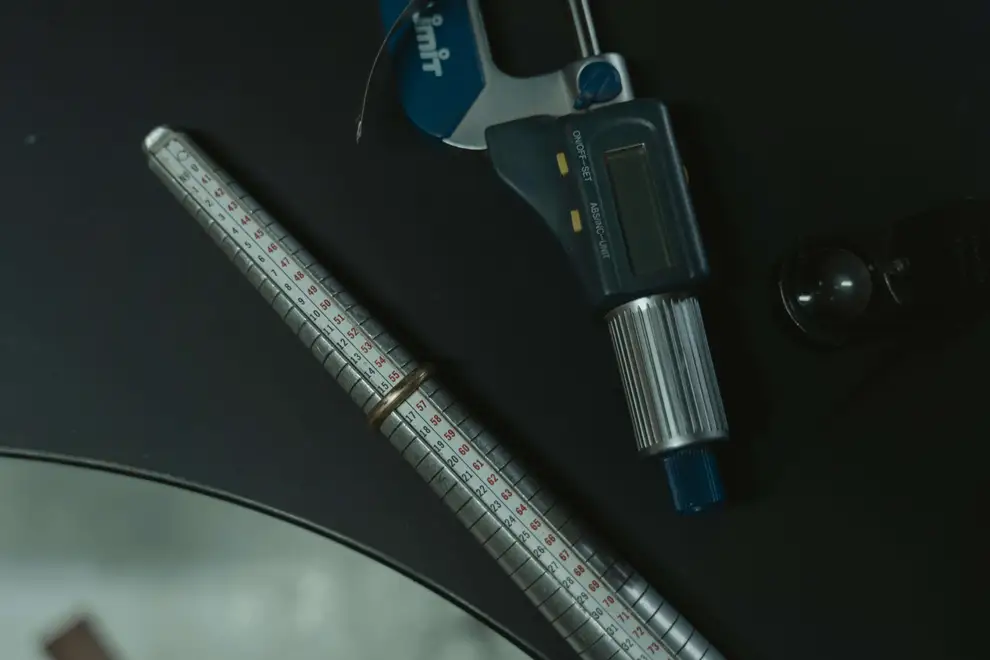
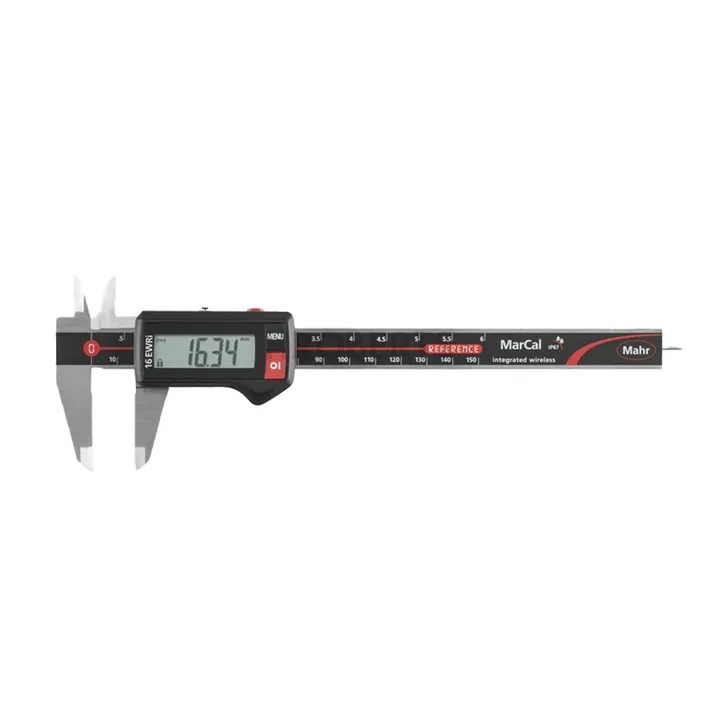
Mechanical micrometers operate on a precision screw thread principle, while digital calipers offer a quick sliding jaw measurement.
Both tools give you a direct reading of a part’s thickness.
You need to be aware of the contact force you apply, especially with softer materials.
Standards suggests taking several measurements at different points and averaging them to get a representative thickness.
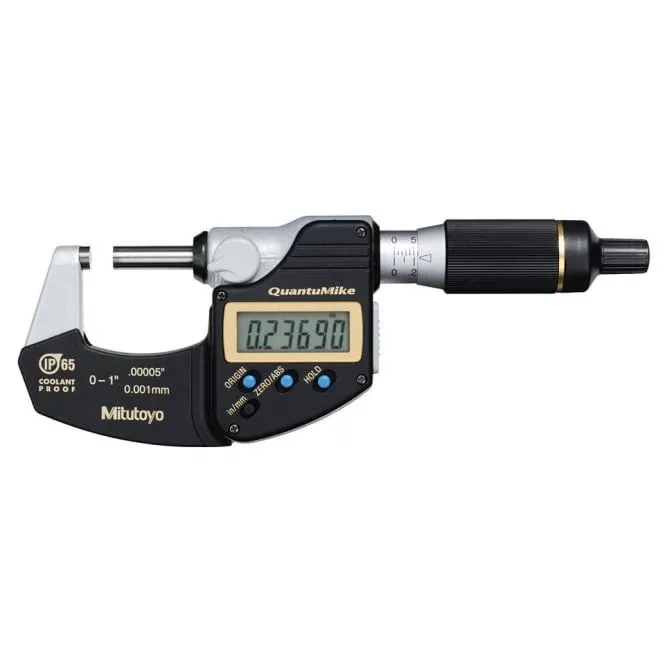
A quality micrometer typically has a resolution between one and ten micrometers. You can verify their accuracy using certified gage blocks.
Dial and Digital Indicators
Dial thickness gauges use a spring loaded plunger for rapid spot checks.
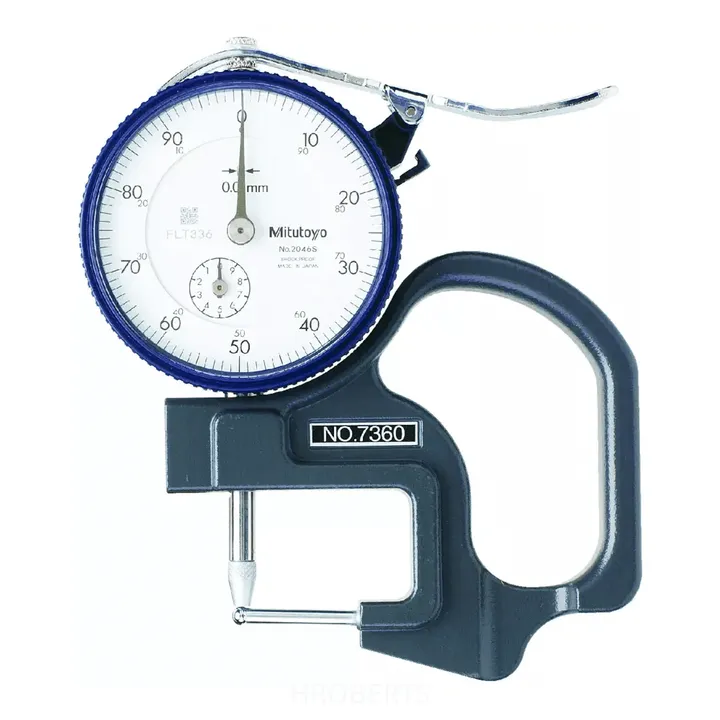
When the plunger makes contact with the part, the thickness is displayed on a simple dial. Digital versions do the same thing but provide an electronic readout that makes recording data much easier.
It’s the modernization of this instrument, but basic principle still works the same.
The main advantage of these indicators is speed. They’re perfect for quick quality checks on a production line.
Proper use requires a flat anvil and firm support for the part being measured.
You must also calibrate it on a reference surface before taking readings, but that’s what you are supposed to do with any measuring device.
They’re commonly used for tasks like confirming the thickness of sheet metal, gaskets, and various molded plastic parts.
Electromagnetic Methods for Coating Thickness
Electromagnetic gauges offer a fast and portable way to check coating thickness without damaging a part.
These nondestructive instruments are a common solution for measuring protective coatings on metal substrates.
Practices for their use are well defined in standards like ASTM D7091-22.
These tools give you quick results needing access to only one side of a surface. After calibration, they require limited operator skill.
The substrate material matters, as magnetic gauges work on ferrous metals while eddy current types work on nonferrous conductive metals.
Readings can also be affected by surface roughness and part curvature.
Magnetic Pull Off Gauges
The mechanical pull off gauge is a simple variant known as a Type 1 gauge in the ASTM D7091 standard.
It uses a permanent magnet and measures the force required to detach it from the coated surface. A thicker nonmagnetic coating reduces this force, which the gauge translates into a thickness value.
Once again, for good results, proper calibration is mandatory.
You should calibrate the gauge on an uncoated sample of the same material as your component. This step accounts for any variations in the base metal’s magnetic character.
Electronic Eddy-Current and Hall-Effect Gauges
Electronic instruments, called Type 2 gauges, provide higher precision.
- Eddy-current probes are built for testing nonmagnetic coatings on nonferrous metals like aluminum.
- Hall-effect probes are applied to measure nonmagnetic coatings on ferrous metals such as steel.
The guidance in ASTM E376-19 recommends calibrating on a substrate matching your part’s material, thickness, and curvature.
You should also be aware of edge effects, since taking measurements too close to a part’s edge can produce inaccurate readings.
Ultrasonic Thickness Measurement
This technique works much like an echo.
A device called a transducer sends a pulse of high frequency sound into a material.
This sound wave travels through the material until it hits the back surface or an internal flaw, then it bounces back to the transducer. The instrument precisely times this round trip.
By knowing the speed at which sound travels through the specific material, known as its sound velocity, the instrument can calculate the thickness.
This process is guided by standard practices like ASTM E797/E797M-21, which outlines the manual ultrasonic contact method.
This standard requires a two point calibration using reference blocks of known thicknesses to bracket the expected measurement range.
Correctly setting the sound velocity is necessary because this property depends on the material’s composition and its temperature.
Accurate readings requires that you use the proper velocity setting for the material you’re inspecting or apply compensation for temperature variations.
One of the main benefits is that you only need access to one side of the component.
This makes it very efficient for inspecting very thick sections, from a few millimeters to hundreds of millimeters. The method is nondestructive and works effectively on most engineering materials, including metals, plastics, and composites.
There are some limitations to consider.
The method requires a coupling medium like gel or water to transmit the sound from the transducer into the part. The surface must also be clean and smooth for good contact.
It’s generally not suitable for measuring very thin films, like those under 0.5 mm.
You’ll find this method used widely for in service inspections.
Common applications include checking pipes and pressure vessels for wall loss due to corrosion. It’s also a key tool for verifying pipeline integrity and examining the condition of storage tank floors.
Plastiform for Inaccessible Areas
What do you do when the area you need to measure is physically impossible to reach?
Maybe it’s deep inside an assembly, behind other components, or in a confined space where no probe or gauge can fit.
This is where replicating materials, commonly called plastiforms or impression compound, becomes your best option.
Replicating material is a moldable compound that you press into the hard to access area.
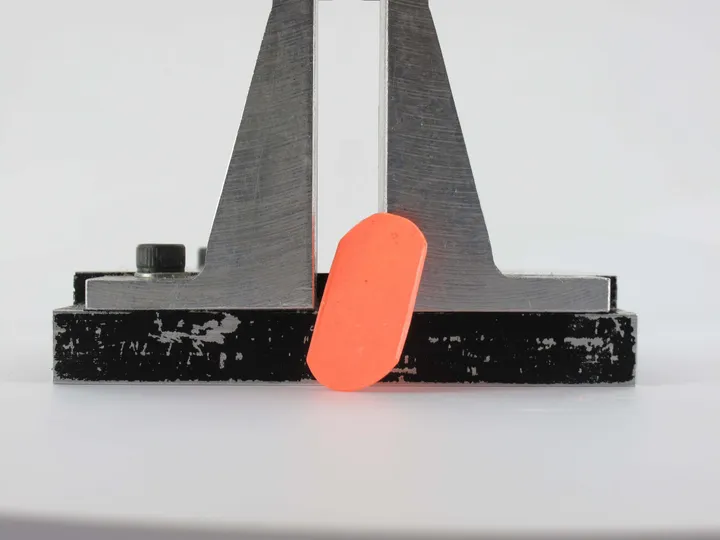
It conforms perfectly to the surfaces, capturing the exact geometry including thickness dimensions and gap clearances.
Once it cures or sets, you extract the replica and measure it using standard tools.
The technique follows a straightforward workflow:
You prepare the replicating product insert it into the target location. The material flows into gaps, around edges, and against surfaces, capturing every detail.
You need to work within the material’s working time, which varies by product type.
After the material sets, you carefully remove it from the assembly.
The replica maintains the exact dimensional relationships of the original space. You now have a physical negative impression of what was previously inaccessible.
With the replica on your bench, you can use any appropriate measurement tool.
Micrometers and calipers work well for simple thickness checks but you need to use a rigid Plastiform product.
This method is particularly valuable in several scenarios.
You’ll use it to verify clearances where disassembly isn’t practical.
It’s the go to technique for checking bearing fits, measuring gaps in turbine blade assemblies or blades thickness to check their weir condition.
Optical and Non-Contact Techniques
Sometimes, you need to measure an object without physically touching it.
This is where optical and non-contact methods come into play. They’re perfect for materials that are delicate, still hot from manufacturing, or moving quickly on a production line.
These techniques are particularly useful for transparent or semi-transparent materials.
They can measure the thickness of a single layer or even differentiate between multiple layers stacked on top of each other.
Think of the complex layers in a smartphone screen or a coated lens.
Many optical methods offer extremely high resolution, allowing you to measure very thin films, from micrometers down to the nanometer scale.
For example, companies like Bristol Instruments offer a family of optical thickness gauges.
These systems use interferometric principles to measure transparent materials from 12 μm to 80 mm thick.
They can even measure up to 31 separate layers at once.
For coatings on opaque substrates, techniques like confocal microscopy and spectroscopy are used.
White Light Interferometry and Confocal Microscopy
White light interferometry works by splitting a beam of light.
One part reflects off the top surface of a film, and the other part reflects off the bottom surface.
When these reflected beams recombine, they create an interference pattern, much like the rainbow colors on a soap bubble.
By analyzing this pattern and knowing the material’s refractive index, we can calculate the film’s thickness with incredible precision.
Confocal displacement sensors offer an other way to measure transparent layers from one side.
It’s kind of like a microscope that only sees what’s perfectly in focus at a single depth. The sensor finds the exact focal point for the top surface and then the bottom surface.
The distance the lens travels between these two points gives you the thickness. This method can resolve individual layers in complex products like lens assemblies or medical contact lenses.
The resolution of these methods is impressive, ranging from tens of nanometers down to the sub-nanometer level.
This makes them ideal for precision optics, semiconductor wafer metrology, and the manufacturing of medical tubing and catheters.
Laser Triangulation and 2D/3D Profiling
Laser triangulation is a straightforward geometric method. If you remember math classes from high school you already know the underlying science.
A laser projects a point or a line onto a surface at a set angle.
A sensor, positioned at another angle, watches this projection. If the surface height changes, the position of the laser light on the sensor shifts.
The system uses simple trigonometry to calculate the distance to the surface in real time.
By scanning a laser across a surface, 2D and 3D profilers can create a complete cross sectional profile or a full 3D map of the object.
This is great for checking not just the height of a coating but also its width and volume.
This capability is useful in applications like inspecting the amount of adhesive applied by a robot or measuring the thickness of solder paste on a circuit board.
Profilers are advantageous for rough or stepped surfaces where a single point sensor might give a misleading reading.
These systems usually operate from a standoff distance of tens of millimeters and can achieve resolution in the micrometer range.
Standards and Calibration Best Practices
A thickness reading holds little value without an objective way to prove its accuracy.
This is why formal standards and traceable calibration are fundamental for regulatory acceptance and quality control.
They provide a shared rulebook for every engineer and technician.
You verify instrument accuracy using certified reference materials like thickness foils or uncoated substrates.
This check should happen before use, after any event that might compromise accuracy, and at regular intervals like the start of a production shift.
Selecting the Right Method for Your Application
Picking the correct thickness measurement tool is all about matching the technology that fits the job.
You need to answer a few questions about your material, your goals, and your work environment. The most precise optical system is overkill if a simple micrometer can do the trick.
Start with the material itself.
Your first question should be about the substrate:
- Is it a magnetic metal like steel ?
- Is it a non-magnetic metal like aluminum
- Is it a non-conductive material like plastic?
This immediately points you toward or away from electromagnetic methods.
Next,
Consider the coating or layer you’re measuring. (if any)
Is it opaque like paint or transparent like a polymer film?
The expected thickness and physical access are your next constraints.
Measuring structural walls in millimeters is a job for ultrasonic or mechanical tools, while measuring sub-micron films requires sophisticated optical or specialized electromagnetic methods.
You need to consider if you can get to both sides of the part for tools like micrometers, or if you’re limited to one sided access, which calls for ultrasonic, electromagnetic, or optical profilers.
Accuracy and throughput needs will narrow your options even more.
High precision applications in optics or semiconductors demand techniques like optical interferometry, whereas many field inspections tolerate lower resolution.
For production, automated optical or electromagnetic mapping systems provide higher speed, while manual contact or ultrasonic gauges are better for spot checks.
The working environment is also an important factor.
A rugged ultrasonic gauge is built for outdoor pipeline inspection, while specialized gear like explosion proof confocal sensors are designed for active coating lines.
You must also balance the initial cost of the instrument, its calibration overhead, and the potential cost of a bad measurement from rework or liability.
All those elements leads you to your options. You might also consider an intermediate replica to fit your measuring device to your area.
Applications and Industry
Theory is one thing, but seeing measurement techniques in action is where their value becomes clear.
All industries face unique challenges, from preventing rust on massive steel structures to layering microscopic films on a computer chip.
The choice of tool and method is driven entirely by these real world demands.
Let’s walk through different real-life exemples to get some guidelines.
Protective Coatings on Steel Structures
For large assets like bridges or ships, the thickness of the protective paint is a primary defense against corrosion.
The industry follows guidelines like ISO 19840, a standard that sets the rules for measurement in that field.
It specifies how to use calibrated electromagnetic gauges, defining a “spot measurement” as the average of several readings and outlining the sampling patterns needed per area to confirm compliance.
Semiconductor and Display Manufacturing
In the world of electronics and optics, you work with multiple, incredibly thin layers.
Anti-reflection coatings on AR/VR lenses or the films inside your phone’s screen for exemple.
Here, white light interferometry is commonly used to measure each layer without contact. Modern systems can nowadays map the thickness of entire lens assemblies, catching any deviations that could affect optical performance.
Medical Devices
When making products like medical tubing, catheters, or intra ocular lenses, you can’t risk damage or contamination from physical contact.
Non-contact optical methods, such as confocal or interferometric sensors, are the solution. They measure thickness with extreme precision using light, which is perfect for delicate, sterile, and transparent materials.
Automotive and Aerospace
Automotive and aerospace industries rely on thickness measurement for both quality and safety.
Paint and plating thickness on a car body is verified against ASTM standards to guarantee durability and a quality finish.
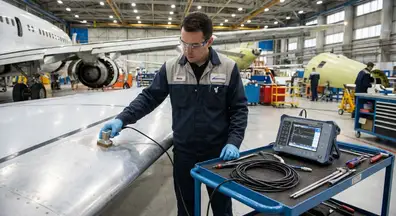
In aerospace, technicians use ultrasonic methods to inspect airframe and engine components for wall loss from wear and tear, an important check to maintain the structure integrity.
Oil and Gas Pipeline Integrity
Maintaining pipelines requires knowing the condition of the pipe wall from the outside.
Technicians use ultrasonic thickness mapping to find areas of corrosion or erosion.
This data creates a “map” of the remaining wall thickness, which is used to predict the pipe’s service life and schedule repairs before a failure can occur.
Conclusion
We’ve walked through the entire toolbox for measuring thickness, from simple contact tools like micrometers to advanced non-contact systems.
You’ve seen how each method serves a purpose, whether confirming a protective coating’s depth to stop rust, verifying a pipe’s wall integrity to prevent accidents, or controlling microscopic layers in modern electronics.
Reliable results comes from following established standards.
These standards point to one central idea: proper calibration using representative materials is non negotiable.
To truly stand behind your results, you must also take measurement uncertainty into consideration.
As technology moves forward, automated sensors and data analytics are making these measurements faster and more precise.
This evolution supports modern manufacturing and inline process control, where accurate data is very important.
Thickness measurement lets you reduce waste, prevent operational failures, and deliver products that meet every specification.
It’s a fundamental element of quality assurance that directly impacts the reliability of your work.
Frequently Asked Questions
Why is measuring thickness so important in engineering?
Accurate thickness governs a product’s strength, quality, and ability to resist corrosion. It’s frequently required to meet safety standards and industry regulations.
What is the main difference between contact and non-contact thickness measurement?
Contact methods use a tool that physically touches the surface, like a micrometer. Non-contact methods measure from a distance using principles like light or sound, which is ideal for delicate, hot, or moving parts.
How do you measure the thickness of paint on a metal surface? You typically use a portable electronic gauge. These devices operate on magnetic or eddy current principles to measure the non-magnetic paint layer over the metal body without damaging the finish.
Can you measure the thickness of a pipe wall from the outside only?
Yes. Ultrasonic thickness gauges are designed for this. They send a sound wave through the material and time its reflection from the back wall to calculate thickness, requiring access to just one side.
What does DFT stand for in manufacturing?
DFT is an abbreviation for Dry Film Thickness. It specifies the thickness of a coating, such as paint or powder coat, after it has completely dried and cured on a surface.
How do substrate properties affect electromagnetic coating thickness readings?
The substrate’s magnetic properties, electrical conductivity, surface roughness, and curvature can all alter the gauge’s readings. For accurate results, you must calibrate the instrument on an uncoated sample of the same material you’re testing.
What is two-point calibration in ultrasonic testing and why is it used?
Two-point calibration involves setting the gauge using two reference standards of known thickness, one thinner and one thicker than your target. This practice corrects for measurement inaccuracies across the working range.
How does ISO 19840 define a \”spot measurement\” for protective coatings?
The ISO 19840 standard defines a spot measurement as the average of a minimum of three individual gauge readings taken within a small, defined area. This approach helps to account for small local variations in the coating.
When should you choose an optical method like interferometry over an ultrasonic one?
Optical interferometry is the better choice for measuring very thin, transparent, or multi-layered films, such as those on lenses or displays, where you need extremely high precision. Ultrasonic methods are built for measuring the total wall thickness of thicker, opaque materials, like metal plates and pipes.